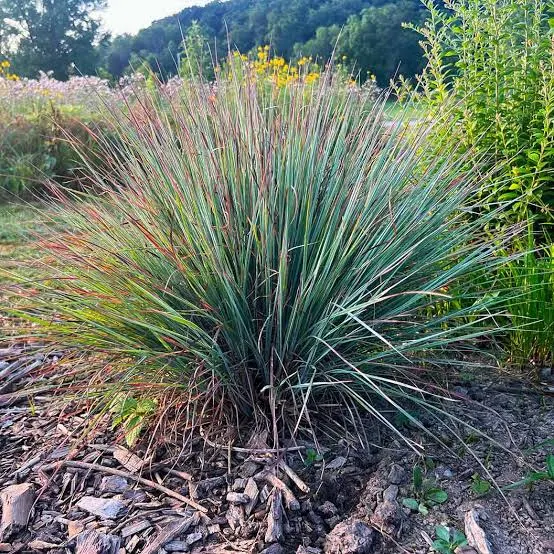
Root and Canopy The Premier Network for Holisic Homesteaders Your Voice Matters! Comment, discuss, and be part of the dialogue. Vote Now Home / Field Guide, Grass , Plant Facts Foliage Persistence: Perennial, warm-season grass; foliage dies back in winter. Sexual Expression: Monoecious; perfect or unisexual florets on the same plant. Lifespan: Typically 10–20 years; clonal stands can persist for decades (Weaver, 1954). Growth Rate: Moderate to fast in full sun and well-drained soils. Life Cycle: Perennial. Pollination: Wind-pollinated (anemophilous). Bloom Period: Mid to late summer (July–September). Morphology & Structure Overall Shape:Dense, upright, clump-forming bunchgrass with narrow, vertical habit; turns bronze to purplish in fall and winter. Mature Height: 2–4 ft. (0.6–1.2 m). Mature Spread: 1–2 ft. (30–60 cm) per clump. Roots: Deep fibrous root system reaching 5–8 ft., providing excellent soil stabilization (USDA NRCS, 2018). Leaves: Simple, linear, 3–10 mm wide and up to 30 cm long, flat or folded; blue-green in summer, turning reddish-bronze in fall; basal sheaths slightly hairy. Stems (Culms): Slender, erect, wiry; often reddish at maturity. Inflorescence: Slender racemes (3–6 cm long), solitary or in small clusters; each spikelet bearing one fertile floret with a twisted awn 8–15 mm long. Flowers: Tiny, reddish at anthesis; wind-pollinated. Bloom Time: Mid to late summer (July–September). Fruit: Caryopsis (true grass grain), 2–3 mm long, light brown with awns; disperses by wind from September–November. Uses & Toxicity Ecological Use: Widely used for prairie restoration, erosion control, and ornamental planting. Valuable forage for livestock during early growth; tolerant of light to moderate grazing (Haddock, 2005). Deep roots make it ideal for soil conservation and slope stabilization. Medicinal and Ethnobotanical Uses: Used historically by Indigenous peoples, including the Cherokee and Lakota, for bedding, insulation, and ceremonial smudges (Kindscher, 1992). Toxicity: Non-toxic; safe for grazing animals and wildlife. History/Folklore:Historically abundant in North American prairies and valued for sod roofing and hay. Indigenous traditions regarded it as a “grass of resilience,” symbolizing renewal after fire or drought (Kindscher, 1992). Symbolism:Represents endurance, resilience, and the regenerative spirit of the prairie. Similar Species & Look-Alikes Similar Species:Andropogon gerardii (Big Bluestem) — taller, with three-part “turkey-foot” seed heads.Andropogon virginicus (Broomsedge) — hairier, with coarser texture and paler foliage. Key References Weaver, J.E. (1954). North American Prairie. Johnsen Publishing. Haddock, M. (2005). Wildflowers and Grasses of Kansas. University Press of Kansas. Kindscher, K. (1992). Medicinal Wild Plants of the Prairie. University Press of Kansas. USDA NRCS. (2018). Plant Fact Sheet: Schizachyrium scoparium (Little Bluestem). Dey, D.C. & Stambaugh, M.C. (2012). Fire in Eastern Oak Forests Conference. USDA Forest Service. Taxonomy Kingdom: Plantae Subkingdom: Tracheobionta Superdivision: Spermatophyta Division: Magnoliophyta Class: Magnoliopsida (Dicotyledons) Class: Liliopsida (Monocotyledons) Subclass: Commelinidae Order: Poales Family: Poaceae (Grass Family) Genus: Schizachyrium Nees Species: Schizachyrium scoparium Etymology: The genus name Schizachyrium derives from the Greek schizo- (“split”) and achyron (“chaff” or “husk”), referring to the plant’s distinctive split glumes. The species epithet scoparium means “broom-like,” describing its fine, tufted form (Weaver, 1954). Other Common Names: Little Bluestem, Beardgrass, Broom Beardgrass, Prairie Beardgrass Management & Propagation Propagation: By seed or division. Seeds require cold stratification (30–60 days at 4 °C) for optimal germination. Best established on sunny, well-drained sites. Pests/Diseases: Generally pest-free; occasionally affected by rust (Puccinia spp.) or leaf spot (Bipolaris spp.). Management: Low-maintenance; tolerates drought, fire, and poor soils. Cut back in late winter or early spring to promote new growth. Ecology and Habitat Habitat: Dominant grass of tallgrass and mixed-grass prairies, open woods, and rocky slopes. Soil Preference: Prefers sandy, loamy, or rocky soils; pH 5.0–7.5. Water Requirements: Low to moderate once established. Sun Requirements: Full sun (≥6 hours daily). Temperature Needs: Hardy to USDA Zones 3–9; tolerates −40 to +38 °C. Tolerances: Resistant to drought, fire, poor fertility, and light salinity. Establishment: Seedlings establish slowly in the first year; root systems develop deeply by the second. Range: Widespread across North America—from southern Canada to northern Mexico, and from the Rocky Mountains east to the Atlantic Coast (USDA NRCS, 2018). Conservation Status: Least Concern (IUCN); populations stable or increasing through restoration. Ecological Benefits: Key prairie species supporting biodiversity and ecosystem stability. Provides nesting habitat and cover for birds such as meadowlarks and quail; larval host for several skipper butterflies (Hesperia ottoe, Atrytone arogos). Contributes to carbon sequestration and soil stabilization. The Premier Network for The Holistic Homesteader Unlock Premium Content! Sign up for our premium membership today. Get It Now Top Posts All Posts Annual Arboriculture Botany Field Guide Flowering Grains Grass Herb Homestead Horticulture Lifestyle Mycology Perennial Shrub Tree Back Plant Biology Plant Identification Pedology Planting & Transplanting Pruning Plant Diagnostics Plant Treatment Tree Risk Assessment Safe Climbing & Rigging Forest Management Little Bluestem by Patrick L. Kimble-December 10, 2025Read More… Forest Resource Inventory & Data Collection Methodologies by Patrick L. Kimble-December 10, 2025Read More… Better Understanding Your Soils Nutriet Cycle: The Key to Healthier Plants by Patrick L. Kimble-November 27, 2025Read More… American Plum by Patrick L. Kimble-November 27, 2025Read More… Cornelian Cherry Dogwood by Patrick L. Kimble-March 11, 2025Read More… Newsletter Unlock Premium Content! Sign up for our premium membership today. Get It Now Field Guide Trees Shrubs Herbs Grasses Grains Flowering Categories Annuals Perrenials Herbs Grasses Grains New Page New Page Sub Title Tags New Page 1 First Sub Title New Page 2 Second Sub Title New Page 3 Third Sub Title Archive New Page 1 First Sub Title New Page 2 Second Sub Title New Page 3 Third Sub Title Free PDF New Page 1 First Sub Title New Page 2 Second Sub Title New Page 3 Third Sub Title 2 Comments Little Bluestem – rootandcanopy.netDecember 12, 2025 at 3:07 pm | Edit Your comment is awaiting moderation. […] Cornelian Cherry Dogwood […] Reply Rosemary – rootandcanopy.netDecember 12, 2025 at 2:34 pm | Edit Your comment is awaiting moderation. […] Cornelian Cherry Dogwood […] Reply American Persimmon – rootandcanopy.netDecember 9, 2025 at 11:18 am | Edit […] Cornelian Cherry Dogwood […] Reply Mr. Judd Turcotte MDMarch 4, 2025 at 5:24 pm | Edit Ea odit et ipsam. Nihil ex

Subscribe to our newsletter for the latest updates, exclusive stories, and expert insights delivered straight to your inbox. Join our community today!
Categories
- Homestead
- Native Roots
- Flowering
- Edible Fruits
- Medicinal
- Trees
- Shrubs
- Herbs
Quick Links
- User Agreement
- Content Guidelines
- Viewing Assistance
- Inclusion & Diversity
- Account Preferences
- Cookie Settings
- Join Our Community
- Company Overview
Contact Us
Consectetur adipiscing elit. Ut elit tellus, luctus nec ullamcorper mattis, pulvinar. tr
- 1910 Madison Ave. Ste.2478 Memphis, TN38104
- +1-(406) 215-5163
- info@etherealdigital.com